Chủ Nhật, 7 tháng 11, 2010


Number 838


The man with the "S" on his chest


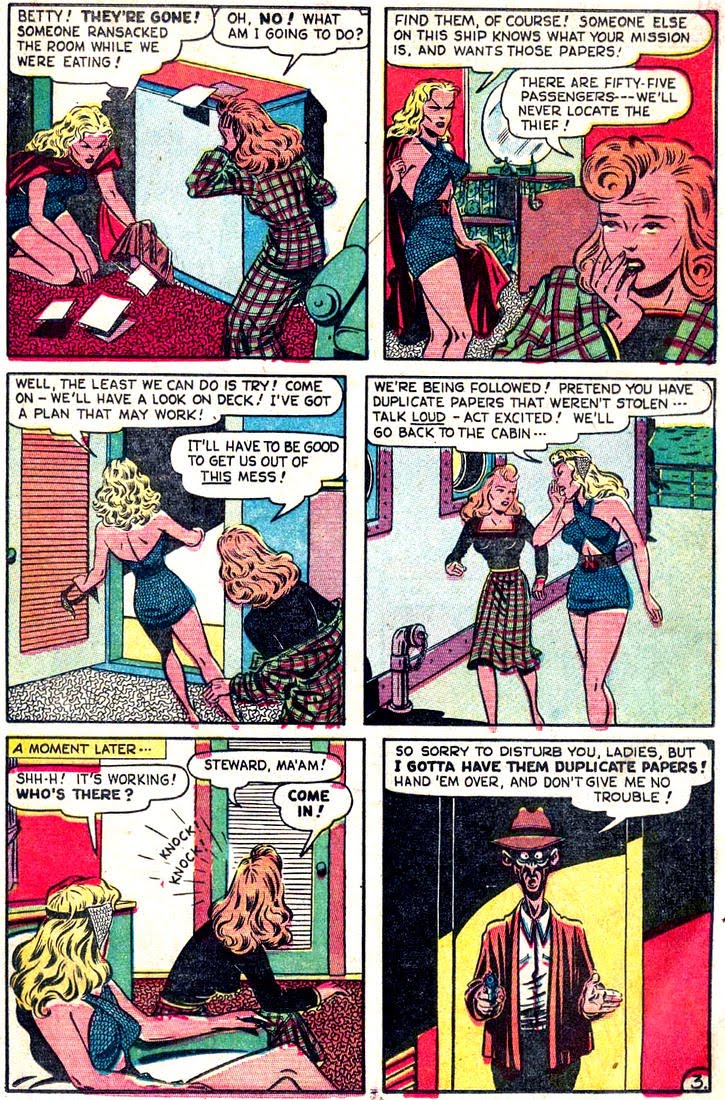
It's been too long since I posted a Bill Everett story, or a story about the character that got Everett started, Sub-Mariner. In this story Sub-Mariner is easy to spot, even in civvies, because he's got an "S" on his chest.

I notice that Namora wears no civilian clothes. She has a cloak which she wears over her sexy swimsuit. In the last panel Sub-Mariner is wearing a suit and tie, yet when being presented a medal Namora is still in her cloak.

It's obvious by looking at this strip from Blonde Phantom #17, Spring, 1948, that Everett had fun drawing. His villains are great. The "steward" at the bottom of page 3, and the bad guy with the piano teeth are very funny. His artistic approach in "The Case of the Deep Sea Swindle" leans toward comedic exaggeration, and I like it.


Thứ Bảy, 6 tháng 11, 2010

The Monster from the Deep

From the November 1954 issue of Web of Evil #20, comes another atom bomb age thingie unleashed from the bottom of the sea-- one that no doubt could give even Godzilla a run for his money!


Thứ Sáu, 5 tháng 11, 2010


Number 837


Straight Arrow


Straight Arrow was a radio program which lasted a short time, shorter than the comic book which licensed the character. I explained some of it in Pappy's #437, where I posted another Straight Arrow story. Fred Meagher was the artist, a solid pro with a flair for Western material. A few years earlier he had done Ralston Purina Company giveaway comics starring Tom Mix. When I read about them in an article years ago (by Ron Goulart?) I also found out that Meagher's name was pronounced Mar.

This is the first story from Straight Arrow #1, published by ME, written by Gardner Fox and drawn by Meagher.

This is dedicated to Mike Britt, Straight Arrow fan. Fifty years ago Mike's fanzine, Squatront #2*, was the first fanzine I ever saw, and is the direct ancestor of this blog. Thanks, Mike.


*(Mike's Squatront was not the Jerry Weist Squa Tront, which came later.)

Thứ Năm, 4 tháng 11, 2010

Secret Six #1


As the 1960s drew to a close, DC began to experiment more. Whereas previous titles had almost always required a tryout issue or two in Showcase, Secret Six debuted in their own magazine. The only earlier Silver Age title I can think of given that treatment was Captain Storm.

The first part of the story is tied up with introducing our six characters. King is a Hollywood stuntman, Crimson is a top model, Carlo is an escape artist, August Durant is a physicist, Lili is a cosmetologist and Tiger is a former pro boxer. We learn that a mysterious person called Mockingbird has a hold over them, and wants them to defeat criminals that the law cannot touch.

The hold he has over them is somewhat like blackmail, although in each case it does not appear to be something the Secret Six member did wrong:

With the arguable exception of King. I point this out because while the idea of the "anti-hero" was very popular at the time, DC was not quite ready to present their readers with characters that were more than a teensy bit flawed, although that would soon change.

To add an element of suspense, it is indicated that one of the members of the Secret Six is probably Mockingbird operating incognito. He (or she) uses his control of the group to force them to attack criminals who are outside the reach of the law. Their initial misson:

Crimson seduces and drugs one of the financiers. Lili then makes up Tiger to look like the drugged moneyman. Carlo uses his escaping abilities in reverse to find a way into the evil genius' hideout.

They succeed in rather undramatic fashion; in the end the criminal dies by his own gadget as is cliche in these stories.

Overall the story (by E. Nelson Bridwell) is entertaining but nothing special. The art by Frank Robbins (Correction: Frank Springer, as pointed out in the comments by Dan) shows some promise; if I recall correctly, this is an early work of his for DC. The series is obviously inspired by the very popular Mission Impossible show on TV at the time.

Update: I read through the next several issues in this series and I have to say that the whole is greater than the sum of its parts. Although the individual stories are not all that strong or unique, I like the way the series develops. As time goes by we learn more about the background of the Secret Six and the people responsible for the problems that Mockingbird exploits to force them to do his bidding--the crooks that wanted Tiger to throw a boxing match, the charmer that conned Crimson out of the family fortune, the torturer who forced King to reveal army secrets, etc.

Update II: Commander Benson's take on the Secret Six series is here. Commander Benson discusses the logic process that led to his deduction of the identity of Mockingbird here. I should mention that in my reading of the series, I noticed that while there were six issues after the first, and that each issue revealed more about the backgrounds of the characters, the only character whom we did not learn more about was the one that Commander Benson identified.

Thứ Tư, 3 tháng 11, 2010

The Half-Creatures of the Sargasso Sea

It's that time of year again when THOIA sets sail into the weird, unchartered waters of the high seas to catch some hideous horrors from the deep! So inflate your water-wings and load your harpoon gun, today we dive into the October '54 issue of Web of Evil #19 for "The Half-Creatures of the Sargasso Sea."


Number 836


The Time Travelers


"The Time Travelers" was a feature of ACG's Operation: Peril, appearing in issues #1-12. Like most of ACG's supernatural/science fiction the Time Travelers stories are equal parts extraordinary events, outrageous hokum and cornball dialogue. In this introduction story, from Operation: Peril #1, 1950, Peggy and Tom, the main characters, outbid some foreign agents for some papers of Nostradamus, which eventually lead to a working time machine.

I did a little reading on Nostradamus, and know he made his "prophecies" in quatrains, and did not deal in explicit events and dates as the Nostradamus of this story does. But this is a comic book, and they get away with the most outrageous plot devices.

The story is drawn by Ken Bald, who went on to a career as a syndicated cartoonist, doing comic strips like Dr. Kildare. He drew the syndicated Dark Shadows, using the pseudonym K. Bruce.

Part two of this story will be available here next Wednesday in Pappy's #840. You'll want to see Tom and Peggy go to Venus in their time machine and Tom get hustled by a beautiful Venusian princess! What did I say about outrageous plot devices?