Thứ Tư, 5 tháng 9, 2012

Number 1222: Paper dolls: Katy and Kitty Kut-ups

Katy Keene had a relatively long run in comics, 1949 to 1961, produced by her creator, Bill Woggon. She was revived by others in 1983 and was published until 1990 by the same folks at Archie. On the other hand, Kitty, drawn by a favorite of mine, Lily Renée, was a one-shot from 1948.

Paper dolls were popular, and I've seen comic books where someone cut them out, thereby damaging the book beyond repair. But I think to do it they'd need sharp eyes and a sharper pair of scissors to follow the outlines of the tiny images published in comic books. If you want to use my scans to print your own go ahead.

Kitty was drawn in 1948 by Lily Renée for St. John with a cleaner, less complicated style than that required by Fiction House, where she drew Werewolf Hunter, Señorita Rio* and the Lost World features. I'd think Kitty would be a natural character for Renée, who wasn't far out of her teens (born 1925). Although born in Austria and a war refugee who became an emigrant to the U.S., she captured the American bobby soxer very well. She claimed she dressed Rio in clothes she wanted to wear, so a paper doll fashion comic book seems a natural.

In 1953 St. John changed Kitty's name to Lucy, and reprinted the story (whiting out Renée's signature) in Lucy the Real Gone Gal #1.
 Bill Woggon got a lot of mileage out of simple storylines about supermodel Katy, her tomboy little sister and several boyfriends. He also helped future fashion designers by providing an outlet for them. They supplied the creations, Woggon drew them up and published them in his comics. Woggon, born in 1911, died in 2003.

I picked this story to show because Katy wears a leopard costume. There is just something about a girl in a cat suit...
 From Katy Keene #2 (1950):


 From Kitty #1 (only issue, 1948):


*I've posted several stories by Renée, but the latest was this one where I told a little of her story: Pappy's #1175.

Thứ Ba, 4 tháng 9, 2012

Perry White, Businessman First, Responsible Journalist Second

I've been working my way through the complete Action Comics run of the Silver Age, and stumbled on this panel:

Gee, Perry, I don't know if this qualifies as a sure-fire gimmick, but I've often thought that maybe you should hire a third reporter and another photographer, and not always send Clark and me out to cover the same story....

In Action #331, Lois bribes a pressman to run off one copy of the Daily Planet with the headline story that Clark Kent is secretly Superman.  However, the joke is on her and Perry, as the pressman is suddenly taken ill and his assistants print the entire run of the paper with that news.  Fortunately, Clark has an idea:
Hey, if it makes the Planet a couple of bucks, who cares if we sacrifice our credibility?

What I find so amusing about this is that Perry could easily be considered a stand-in for Mort Weisinger.  Think about it; Weisinger was always using gimmicks to sell Superman comics, from Imaginary Stories to fake covers, to dream sequences, to Red Kryptonite stories.  And, I might add, he was very, very successful at this, which undeniably made his bosses at DC quite happy.

Any more examples out there of Perry looking for gimmicks to boost circulation?  I am sure there are plenty.

Thứ Hai, 3 tháng 9, 2012

Number 1221: Post ghosties

Here are a couple of excellent examples of why Howard Post was one of the best pure cartoonists to work in comic books. These two stories, first from Harvey Comics' Spooky #3 (1956) and the second from Spooky #9 (1957), are full of action, funny characters and move like animated cartoons.

My favorite of the two is “Legend of Creepy Hollow,” and its story of old ghosts being dispossessed of their haunted house. Spooky solves their problem by hauling them to town in a wagon where they scare the townsfolk. What it reminds me of is me and the rest of the aging Woodstock generation, moving into retirement and scaring those who think we're going to take all the government benefits and leave you young folks nothing! So, BOO! Bwaaaaaa-hahaha!

There's more Howie Post (including scans of original art) in Pappy's #1086.


Chủ Nhật, 2 tháng 9, 2012

Number 1220: Not your average palooka


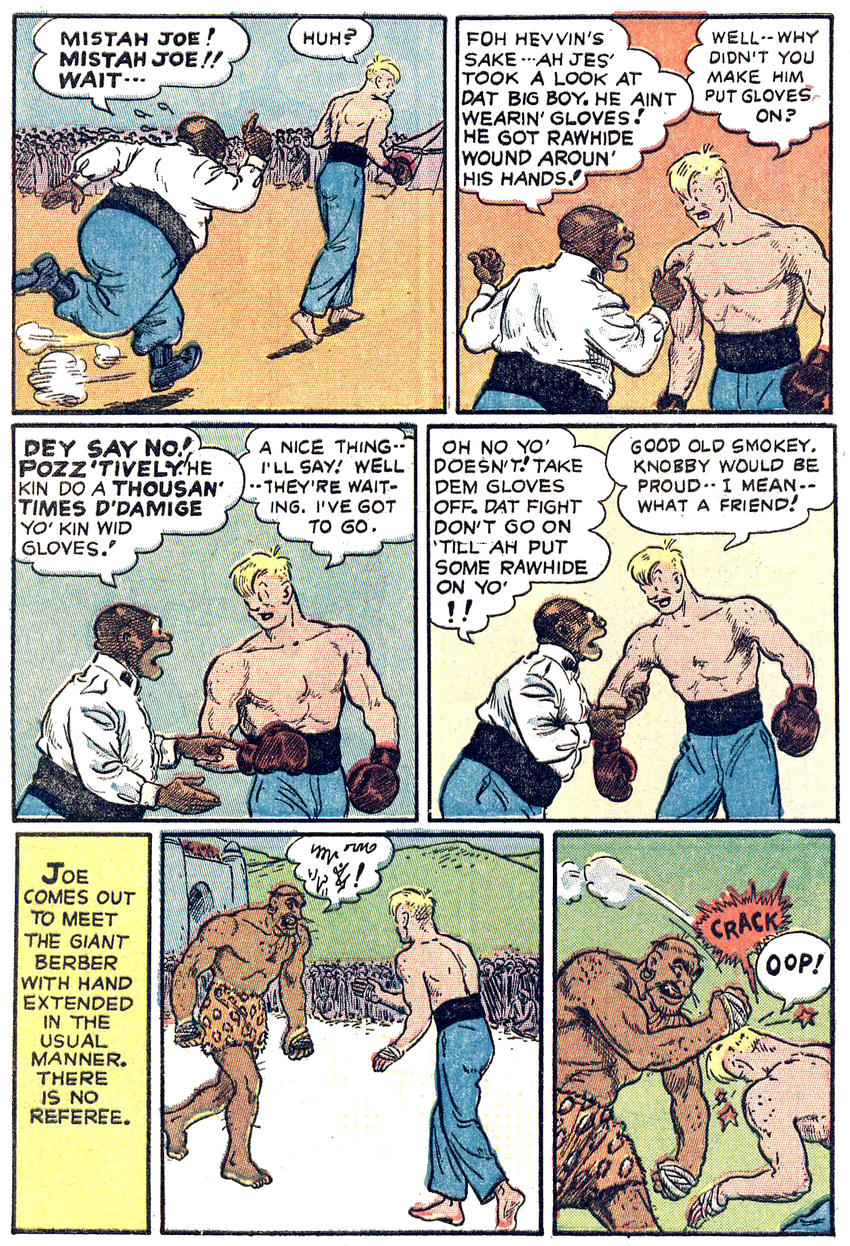
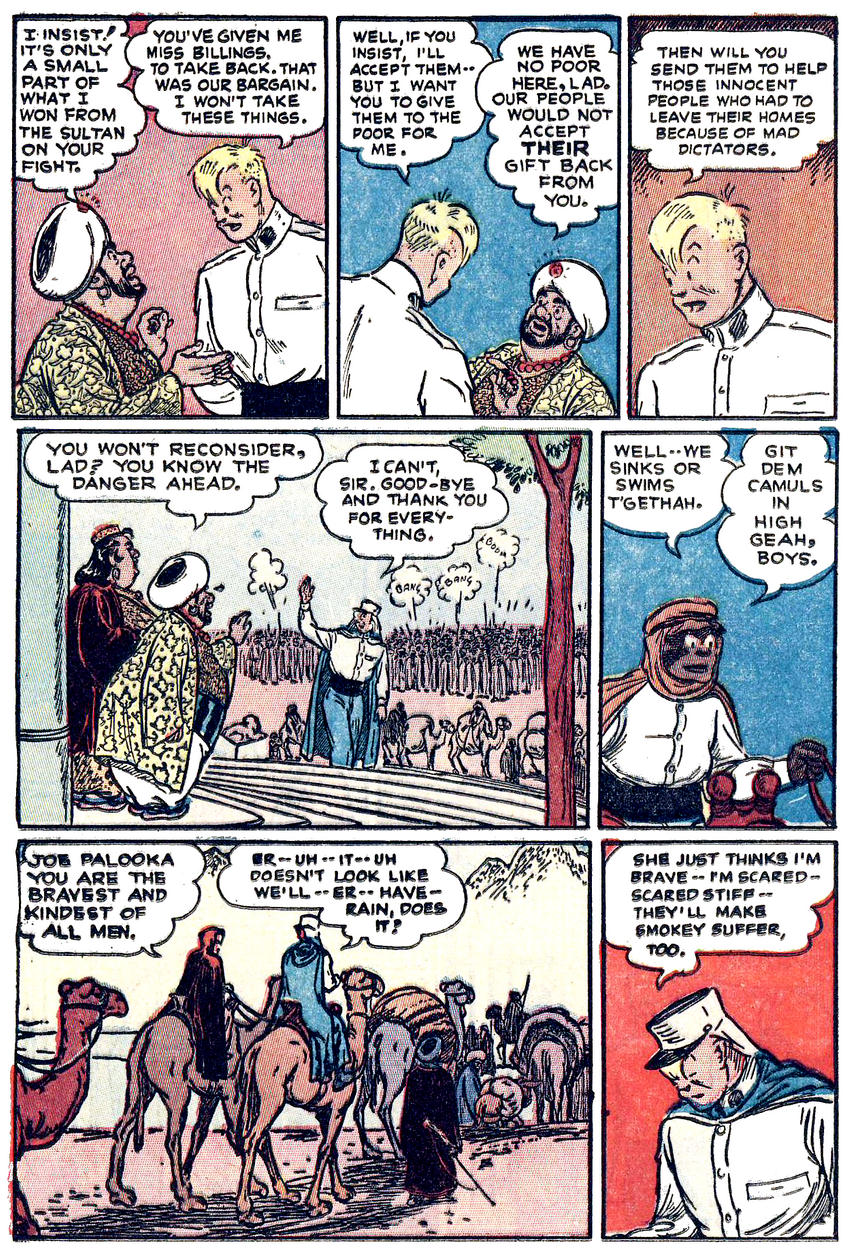
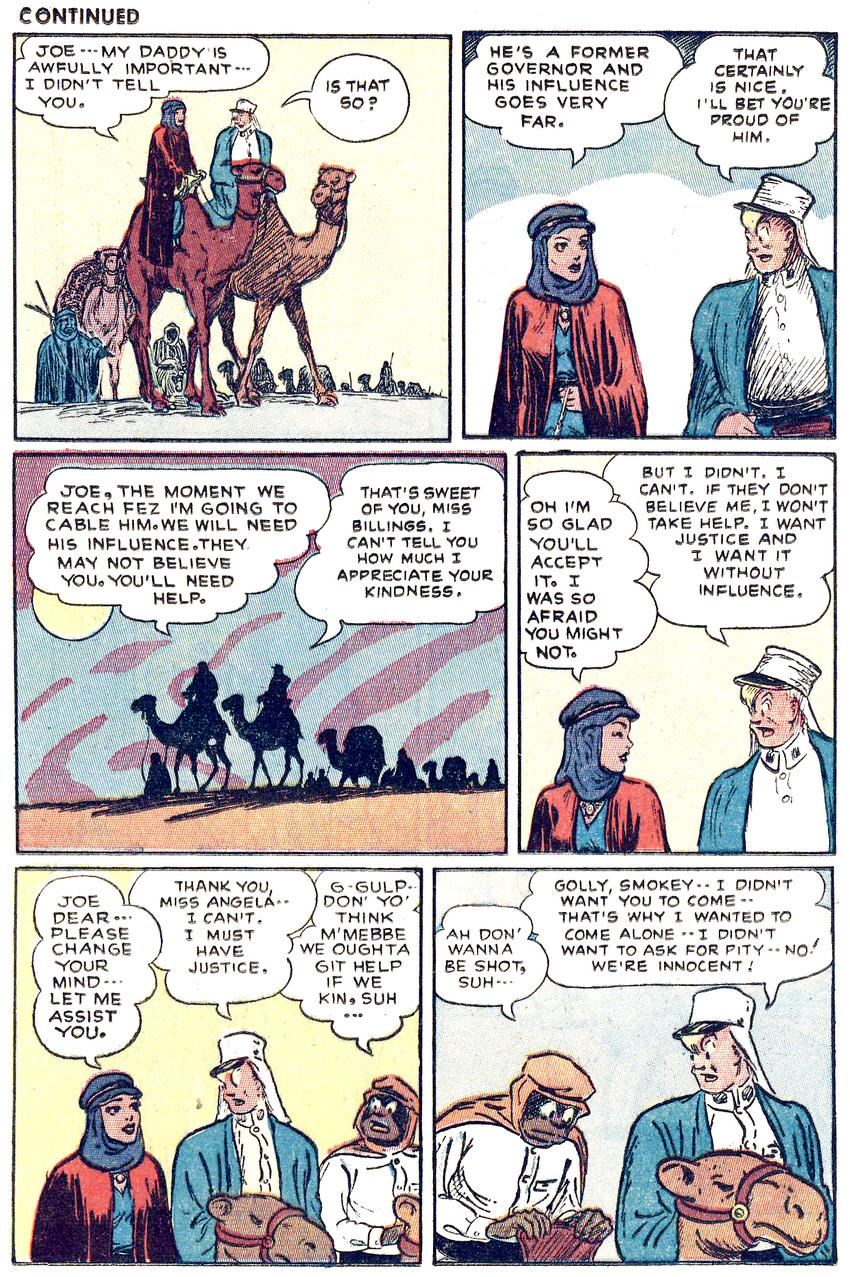
My American Heritage Dictionary defines “palooka” as an “incompetent or easily defeated person, esp. a prize fighter,” but they can't be describing Joe Palooka, who was heavyweight champ. In the funny papers, anyway. Joe Palooka was one of the most widely read and widely recognized comic strips in the world. By 1948, when the issue of Joe Palooka Comics I'm showing today was published, it was among the top five comic strips. The strip was created by Ham Fisher in 1921. Fisher was assisted by Al Capp for a time in the 1930s, which led to a feud when Capp left and created the successful comic strip, Li'l Abner, the idea for which Fisher claimed was stolen from his strip.

Joe Palooka's peregrinations were of public interest; his time in the French Foreign Legion was a pre-war continuity, followed in over 900 newspapers. Joe was finally free from his five-year enlistment with the help of FDR. Yep, President Franklin D. Roosevelt himself showed up in a couple of panels asking for Joe to be released from his commitment. That presidential sequence is missing from this reprint, which is the tail end of the Foreign Legion story. It's alluded to, but not shown, and probably because by 1948 FDR had been dead for three years.

Regrettably, some of the thoughtless racism of the era is right up front. Joe's pal, Smokey, while treated as an equal by Joe, is an ugly caricature. My apologies to all who may be offended.

I believe the art is by longtime Fisher assistant, Mo Leff, who ghosted for Fisher, and did not sign the strip until 1955, after Fisher's suicide.

From Harvey Comics’ Joe Palooka #22, 1948: