Thứ Bảy, 23 tháng 2, 2008

The 3/4 Shot

Mark Engblom has a very cool post up about Robin, and the seemingly endless ways he appeared on DC covers looking on and commenting as Batman performed some amazing feat. The on-looker in a 3/4 shot was an important part of making the panel or the cover seem three-dimensional. It gives us a close, recognizable person so we can gauge the relative size and nearness of everything else in the view. This is used endlessly throughout the Silver Age. Look at every panel on this page:


You can see that in every case there is somebody standing in one or the other bottom corner who is the closest to the "camera", thus giving us scale. But notice that they do not have always the same angle that they're looking at. In the first panel, a salesman is looking directly left. In the second, Lois is looking back and left. In the third, the professor is looking forward and left Then we see Lois looking right, then left, then the professor looking forward and left.

I tend to think of the camera angle where the person in the foreground is mostly facing away from us as the 3/4 shot, because the onlooker is 3/4 looking away from the camera. In this page the third and sixth panels are used this way. In the ones Mark has posted of Robin, I believe that if you look closely at them, you'll see that every one is a 3/4 shot. Granted Moldoff doesn't make this clear always until you look at the set of the shoulders.

Now, here's the thing. The world's worst comics artist at drawing the 3/4 shot has to have been Wayne Boring, one of the major Superman artists of the Silver Age of Comics. And the main reason why was because he just could not place the eyeglasses on a character to save his life.

We have two examples right on the page I posted above:


You can see the problem, right? The angle is all wrong on the glasses; they look like they're about to fall off his nose, rather than balanced on the bridge. This is a major artist, on a major character who often wore glasses (as Clark Kent), and the artist just couldn't get it right:


And it went on for years. We all bow down before Weissinger, who undeniably created an amazing decade for Superman, but how do you ignore the fact that he let this travesty go on with the glasses?


It's not as if DC didn't know where to put the glasses; Al Plastino knew where they belonged:


Boring was a terrific artist in the Golden Age, and I would not have been able to draw anywhere near as well as he did on his worst days. But he almost never got the glasses right.

Thứ Sáu, 22 tháng 2, 2008


Number 265


Vampire At The Window!


"Vampire At The Window," a shorty originally from Astonishing #18, is written by Stan Lee and according to the Atlas Tales site, drawn by Hy Rosen. What I like about it is the creepy Max Schreck-Nosferatu vampire.

I scanned this from tear sheets. It's from a Marvel reprint of the 1970s.


Scarecrow At The Window!

My local library carries graphic novels in three areas, adult, young readers and juveniles, so I check all three. I ran into this volume, Goosebumps 3 Ghoulish Graphix Tales #1 in the juvenile section, for the little kids. All three stories have their merits, but "The Scarecrow Walks At Midnight," adapted and illustrated by Greg Ruth, is my favorite. This particular sequence was especially creepy. I'm sure if I'd seen this when I was a little kid I'd still be in therapy today. Grandpa creeping in the window in the middle of the night…then Grandma shows up...both of them with lips sewn shut, …yow. Can I sleep with the light on, Mom? And Grandma and Grandpa aren't coming to visit anytime soon, are they?


Thứ Năm, 21 tháng 2, 2008

Late 1967, Early 1968 Ads


Obviously ahead of their times, the Mothers of Invention ran ads that did not make it clear what they were advertising.

Thứ Tư, 20 tháng 2, 2008

When I'm the Evil Genius

I will not disgrace my enemies before eyes of the entire world:


Number 264


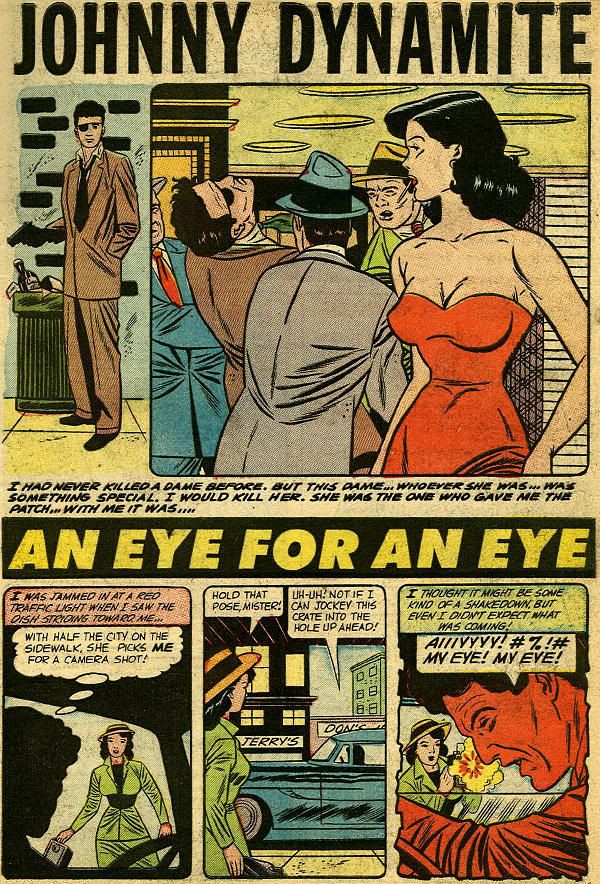
Never trust a dame


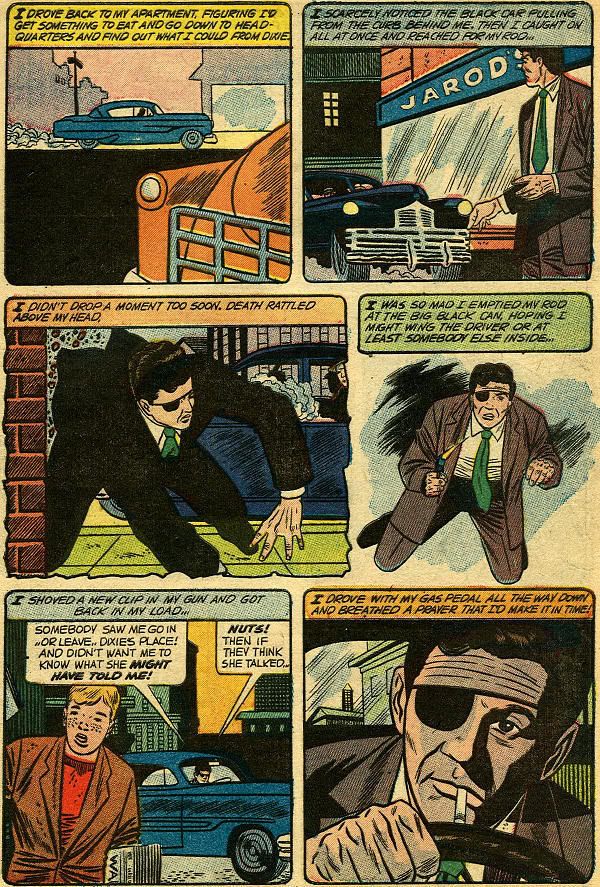
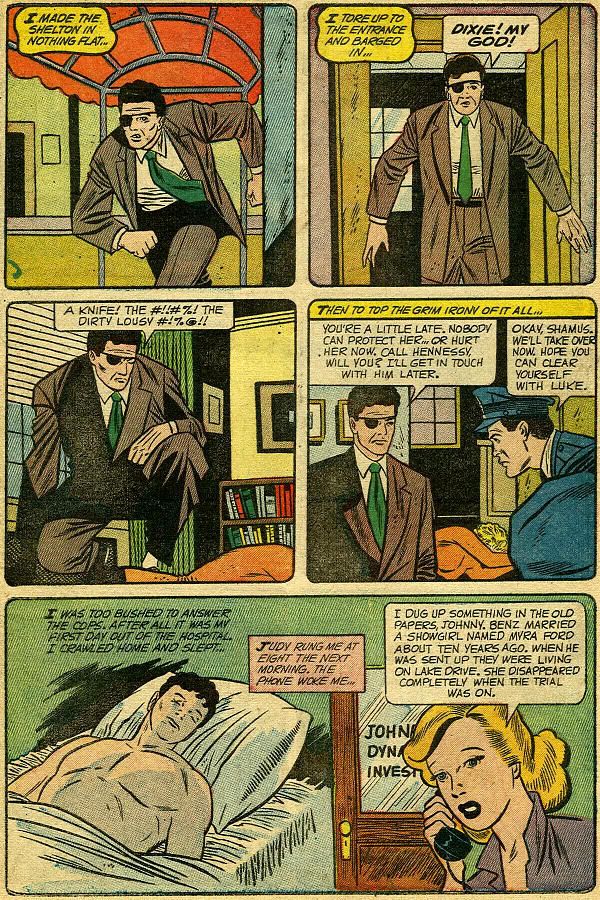
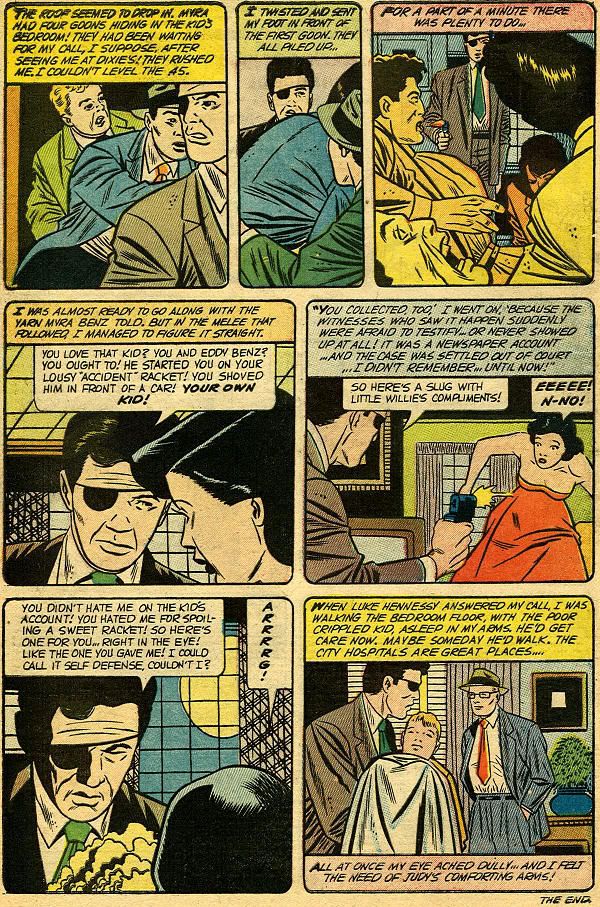
Poor Johnny D. The lady with the camera shot his eye out. It must've been a pretty fancy camera if it could do that! Now he's looking for payback. He gets it in the next to last panel when he returns the favor. I guess gut-shooting and then eye-shooting the dame who de-lamped him is justice, even though she's got a crippled kid in the next room!

Such was the violent world of this Mike Hammer-styled private dick, from Dynamite #4, published by Comics Media in November, 1953. The artwork is by Pete Morisi, later known as PAM in the Peter Cannon Thunderbolt comics from Charlton. The story, likely written by William Waugh, bylined as the writer of another story in the issue, is a document of its time, an attempt to take adult paperback sleaze and turn it into comic book sleaze.

Oh yeah…despite the similar names, there's no truth to the rumor that Johnny married his secretary, Judy, and had a son.


Page 1 / Page 2 / Page 3 / Page 4 / Page 5 / Page 6 / Page 7 / Page 8

Thứ Hai, 18 tháng 2, 2008

The Blinded Daredevil

A play, as George M. Cohan pointed out, is composed of three acts. In Act I, you get the hero up a tree. In Act II, you throw stones at him. In Act III, you get him down from the tree. Many superhero stories follow this simple formula. But there are two rather crucial parts that sometimes don't work. First, the stones thrown at the hero in Act II can't be too deadly. And second, the method of getting him down from the tree must be credible.

In Daredevil #30-32 (July-August, 1967), Stan went a little too far on both counts. The series features Daredevil against the old Thor villains, Mr Hyde and the Cobra. Matt figures out that they must be behind the series of robberies in the city. And since he reasons that he can't just patrol the city to find them, he decides to dress up like Thor to draw them out.

Well, you can probably see the fly heading rapidly towards that ointment. Sure enough, Don Blake hears that Thor is plying his trade in midtown and pounds his cane. Before you can say Ragnarok, Thor and DD are doing the classic Marvel, "I'm a hero and I know you are too, but let's fight for a couple pages so they can put it on the cover!" routine.


But eventually they stop clobbering each other and Thor flies off. And the villains DD had been hoping to attract show up. At first they attack him, but Mr Hyde has a better plan--let him follow them back to their nearby lab, where:


Well, the stuff in the test tube is supposed to make one blind. But since Daredevil is already blind, it has no effect, right? Heheh. Sorry, Marvel science doesn't work that way. Since he's already blind it takes away DD's special powers of hearing and the other senses he uses to compensate for his blindness.

Okay, so the hero's up in the branches and leafs and the stones are being hurled at him. But the story takes a twist. Mr Hyde and the Cobra, sensing that DD is no longer a threat, abandon him. DD somehow manages to find his way back to his apartment (apparently not thinking of changing his clothes). Matt does some heavy thinking. Since Foggy and Karen know DD is actually Matt's supposed twin brother Mike, if Daredevil is suddenly blind he'd better make sure that Mike appears to have been blinded as well.

And if the logic of that is as impenetrable to you as it is to me, congratulations, you've been paying attention, because none of this makes a whole lot of sense. So Mike shows up at the office, displaying signs of having lost his eyesight. Karen of course reacts selflessly:


Fortunately the tender scene is broken by the Cobra and Mr Hyde, who have taken up occupation of a nearby rooftop and are threatening havoc. So Mike gets into his DD duds, gets Foggy to help him up to the top of their building, so he can throw his billy-club line across to the villains. And DD tight-ropes his way across the wire, blind and unaided by his other senses, which freaks the crooks out so much they take off.

But they come back and realize that DD is indeed still blind. So they decide to take him back to their lab. Their other lab, not the barn they were in during the battle two issues ago. This one is in a lighthouse. DD goes along with them because he knows he needs the antidote, which Hyde has surely prepared for his blindness potion. And of course once they get to the lighthouse there is a battle, DD eventually gets the antidote, and fortunately guesses right that it has to be swallowed, not splashed on the side of his head like the original potion:


From there, DD makes short work of the Cobra, although Mr Hyde is able to escape. It's an entertaining storyline overall, but it strains credulity to the snapping point. The stones are too rough, and the way that the hero gets down from the tree is not believable.

Number 263


Cold war on a cold moon


In the 1950s we lived in a state of paranoia. A lot of people believed that at any time atom bombs would rain down on us. It was the fault of those damn Reds, you know, the Enemy.

Luckily it never happened. But I wasn't surprised when I read "Lunar Trap" in Race For The Moon #2 in 1958, that the Enemy would be up to no good when we all got to the moon. Imagine my surprise at the soft ending. Imagine someone thinking we could ever be at peace with those guys! Decades after reading this story I read of a real-life plan by the U.S. military for installing bases on the moon by 1965, where we could have nuclear weapons pointed at the Soviet Union. Now that's paranoid!

Jack Kirby drew--and I presume, wrote--a good story with an interesting premise. In the 1950s the idea that a woman could be in charge of men seemed ludicrous to us Americans; surely that was only a commie idea. But Kirby--despite a leering remark, "A lady colonel. Now this is more to my liking!"--handles a potentially sexist situation pretty well.

Unlike most of his monster stories this time he only indicated the monster with partial, silhouette or long shots. Inking is by Al Williamson.