Hiển thị các bài đăng có nhãn funny animals. Hiển thị tất cả bài đăng

Thứ Sáu, 2 tháng 11, 2007


Number 212


Three Mouseketeers


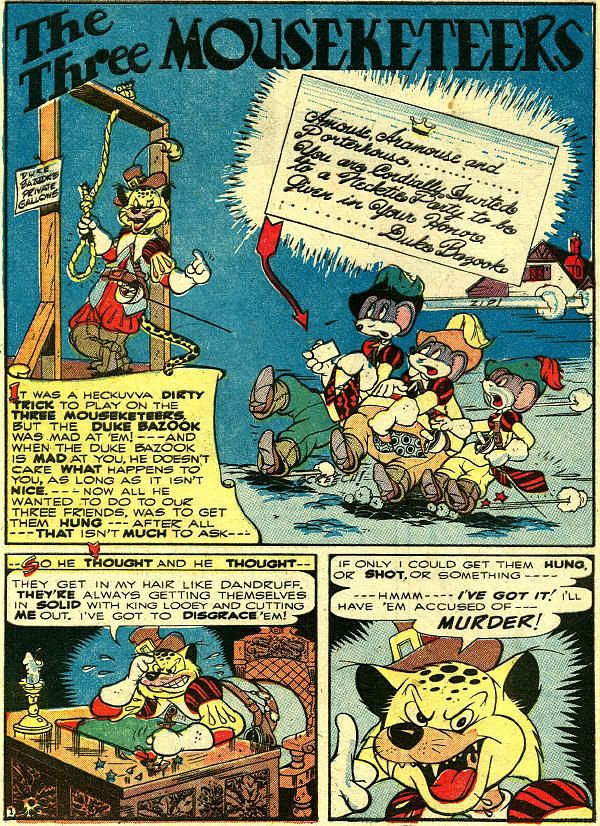
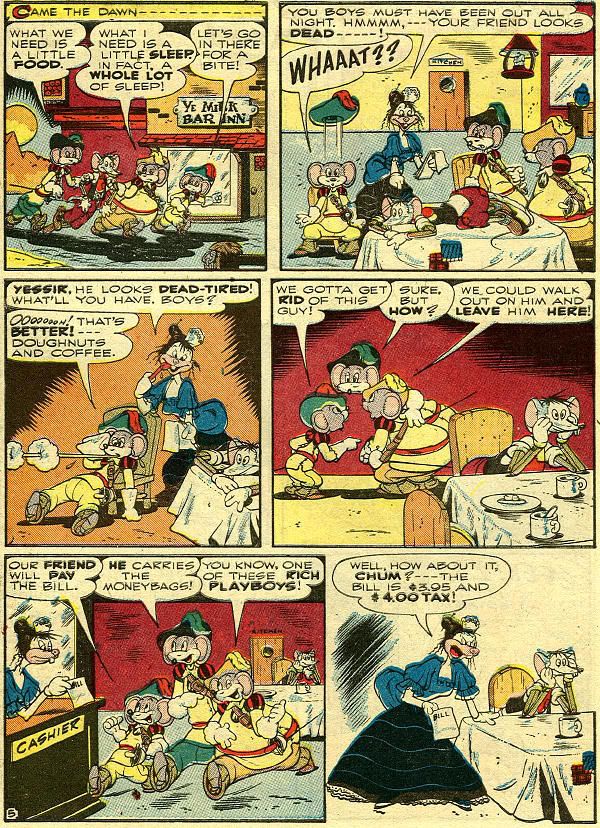
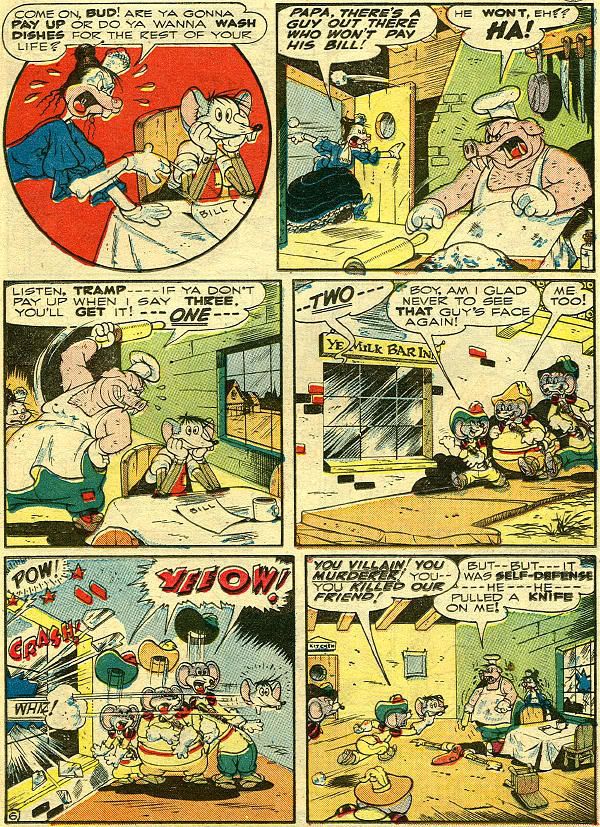
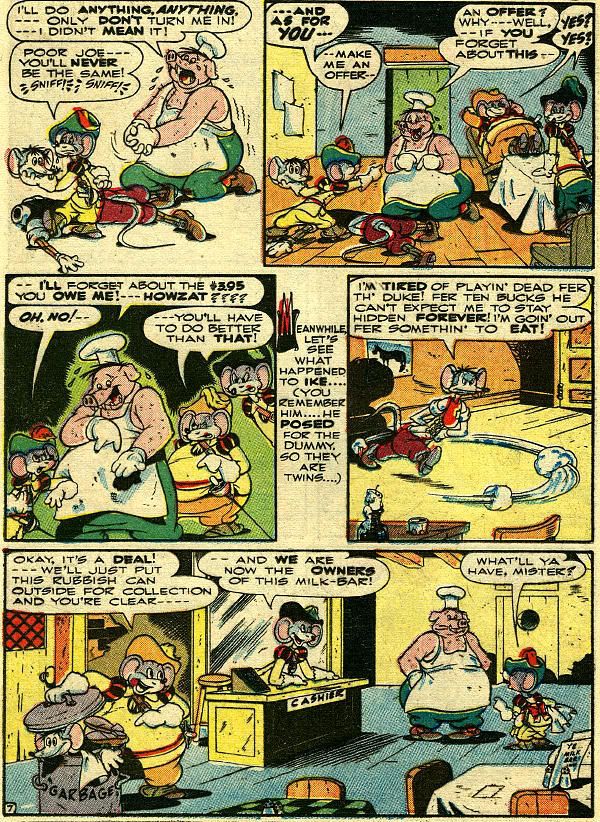
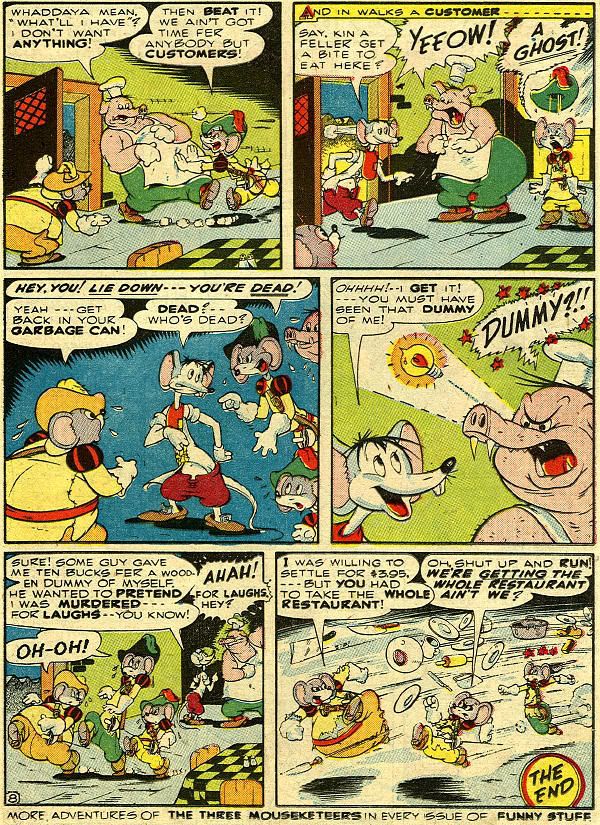
DC had two sets of characters called Three Mouseketeers. The first was introduced in Funny Stuff #1 in 1944, and was a takeoff on Alexandre Dumas' famous literary characters. The second set was introduced in 1956, drawn by Sheldon Mayer, who had edited the first series. It was more contemporary, featuring a sort of Tubby and his Clubhouse Pals, mouse style. The characters, Fatsy (also called The Captain), Patsy and Minus were the Mouseketeers.*
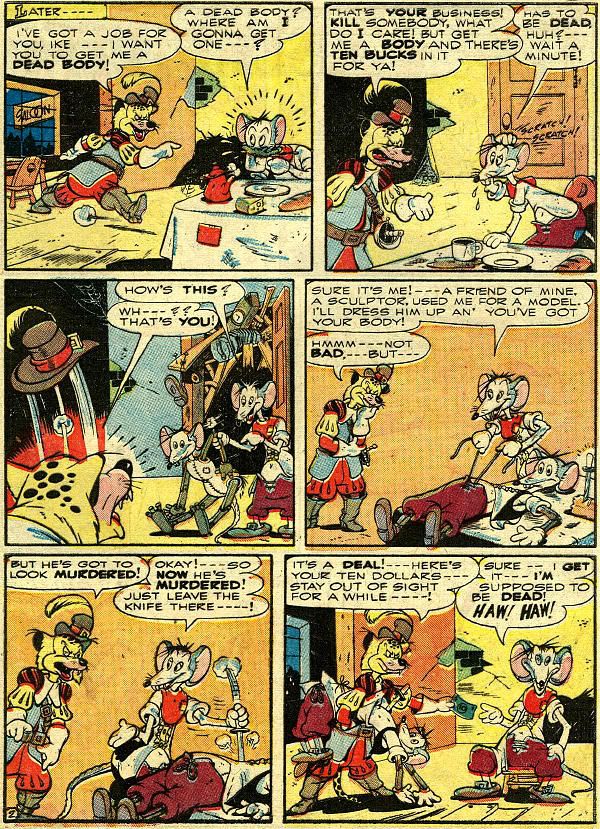
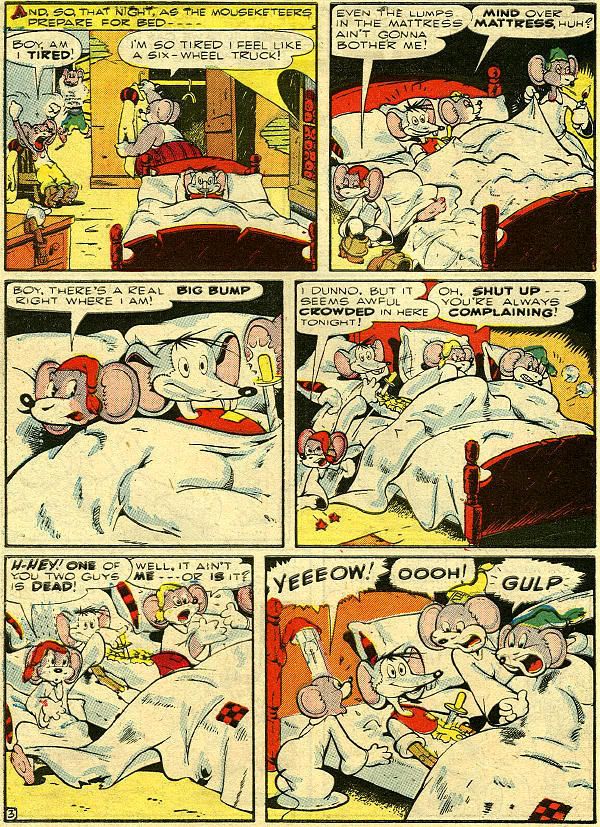
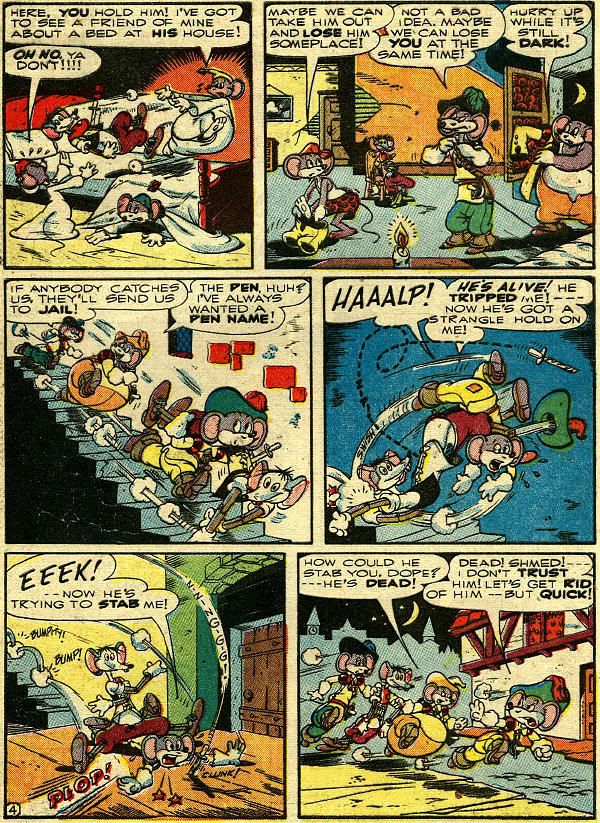
This unnamed story is from Funny Stuff #6, Fall 1945. At the time it was published by Max Gaines' former division of DC Comics, All-American. By Funny Stuff #7 All-American and DC had kissed and made up, then reunited. From there Max Gaines went on to create EC Comics.The fine artwork is unsigned, although the Grand Comics Database credits it to Ron Santi, who signed the "Bulldog Drumhead" strip in the same issue as R. Santi . "The Three Mouseketeers" episode seems a morbid story for a kids' funny animal comic book, but then as now, murder is entertainment. At least in this story the murder victim wasn't really a victim, or even murdered.

Page 1 / Page 2 / Page 3 / Page 4 / Page 5 / Page 6 / Page 7 / Page 8

*We're also all aware of Disney's TV Mickey Mouse Club and the Mouseketeers.

Thứ Năm, 11 tháng 10, 2007


Number 202


Supermouse gets hot under the collar!


"The Good Old Wintertime" is from Supermouse #2 (1948. Supermouse, created by Kin Platt in 1942, first appeared in Coo Coo Comics.

I've seen quite a few Supermouse stories, and it was my opinion this was drawn by Gene Fawcette. However, after initially posting this entry I got a note from cartoonist Jim Engel with the following information:

For some reason, I can't post this under "comments"...if you CAN, please DO... The 2 Supermouse stories you've posted are not by Gene Fawcette---they're actually drawn by Milton Stein. Fawcette DID draw SM stories and covers, but later in the series. Fawcette's SM has weird "chopped" or "squared off" feet, as an identifying tip...and he did a lot of SM cover where SM is drawn pretty huge, catching Terrible Tom in nets, etc... Many people DO seem to regard Stein as "THE" SM artist, but the strip was drawn by a veritable WHO'S WHO of funny animal greats, including Al Hubbard, Jack Bradbury, Dan Gordon, and Don Arr... best, Jim Engel

Thanks for your input, Jim! You're quite the great cartoonist, yourself.


Thứ Tư, 12 tháng 9, 2007


Number 188

The Not-Quite-Kelly


Howie Post is one of those comic artists who worked in the business for so many years his work is everywhere. This particular strip, from DC's Animal Antics* #9, July-August 1947, was drawn when Post was only 21 years old, based on his birth year of 1926. He started in comics when he was still in his teens, not as young as Joe Kubert or Frank Frazetta, but still a prodigy, as far as I'm concerned.

In his later career Post did a daily syndicated comic strip called The Dropouts, and Harvey Comics are filled with his pages, mostly in Hot Stuff. The Little Devil and Spooky, The Tuff Little Ghost. He has a very appealing style, full of action and humor, as this page from a 1976 issue of Hot Stuff shows.

Post's early art was inspired by Walt Kelly. According to Post he met with Kelly and comic book packager Oscar Lebeck about doing work for them. His method of inking and penciling was inspired by Kelly, but different enough that it is wholly Post. "Presto Pete" is a funny animal magician strip. I think it's quite good. I don't know if Post wrote his own material, but it's well done. Rather than being a clone of Walt Kelly, Howie Post went on to develop his own style, instantly recognizable. That is until he invented Anthro for DC Comics in 1968, where he went from funny devils, funny ghosts and funny animals to funny cavemen.


*Post mistakenly calls Animal Antics a book he packaged for Timely (Marvel), rather than DC in his TwoMorrows interview from Comic Book Artist #5. This is the danger of interviews with artists who have fallible memories stretching back five or six decades, or even more.