Chủ Nhật, 9 tháng 1, 2011

D2-114 - "Black Out" (6/18/79 to 8/18/79)

Flash Gordon D-2 Series Strip 
Art: Dan Barry 

Summary: Readying themselves for their graduation test flight from Earth's Space Academy, The Space Kids are reunited with Flash as they set off on a faster-than-light flight to the stars.

But on reaching the star system Alpha Centauri, Flash’ ship is stopped by a completely black vessel and boarded by some light-shy characters with an ability to shroud their surroundings in complete darkness...
(Source of summary: www.ipcomics.net)  


It's from Emile's e-collection. All credits go to her & "Allen Lane" who scanned and first shared at net. 

This strip was printed in Indrajal comics "#343-1980-The Black Stinger" as 2nd comics. One can download IJC version (i.e.coloured comics) from our MEGA IJC blog: HERE.

NOTE: The major part of Indrajal Comics' Flash Gordon stories are Dan Barry's the Daily (D-2) and the Sunday strips.

Number 875


The Duke and the Prince


From a cursory look through the Grand Comics Database, I see that the Joe Simon Harvey Comics features, "The Duke of Broadway," and "The Vagabond Prince" had a total of 4 and 2 episodes respectively. As the Jack Kirby Museum website noted, the features that Simon and Kirby created for Harvey after World War II were released during a comics glut, and were short-lived.

Both of these stories are from Black Cat Comics #7, 1947. The Grand Comics Database says Kirby penciled the splash pages on both, and Simon penciled and inked the remaining pages. The Kirby Museum says they are both all Simon. I like the artwork regardless of who did what. It's sometimes forgotten that Joe Simon could draw, not just ink.


Thứ Bảy, 8 tháng 1, 2011

D2-113 - "Ming's Women” (2/26/79 to 6/16/79)

Flash Gordon D-2 Series Strip
Art: Dan Barry


Summary: Realising that she is no longer Ming’s favourite consort, the harem girl Verma seeks refuge in Arboria, where she infiltrates Prince Barin's inner circle as companion to Thalia (see D2-112 Odyssey) in a bid to deliver Flash and Dale to Ming and regain the latter’s affection.

But trouble is brewing on several fronts: ignorant of Verma's scheme, Ming sends a large suicide squad to Arboria to kill Flash and capture Dale...
(Source of summary: www.ipcomics.net)  

Download 

It's from Emile's e-collection. All credits go to her & "Allen Lane" who scanned and first shared at net.

Thứ Sáu, 7 tháng 1, 2011

D2-112 - "Odyssey” (11/20/78 to 2/24/79)


Art: Dan Barry
Summary: Leaving Mongo’s Mystic Isles by boat (see D2-111 Slaves), Flash loses Thalia to a group of nomad fishermen who leave Flash for dead in the middle of the ocean.

Coming to, Flash is rescued by a group of robot beach scavengers who are able to equip Flash with a motorised boat. Before long Flash has sighted the pirate schooner, the first of many trouble-spots still lying ahead on the treacherous journey through Ming’s territory...
(Source of summary: www.ipcomics.net)

Download

It's from Emile's e-collection. All credits go to her & "Allen Lane" who scanned and first shared at net.
P.S: D-2:107 link is working now.

Number 874


EC's only superhero(ine)


This is the last day of our EC theme week.

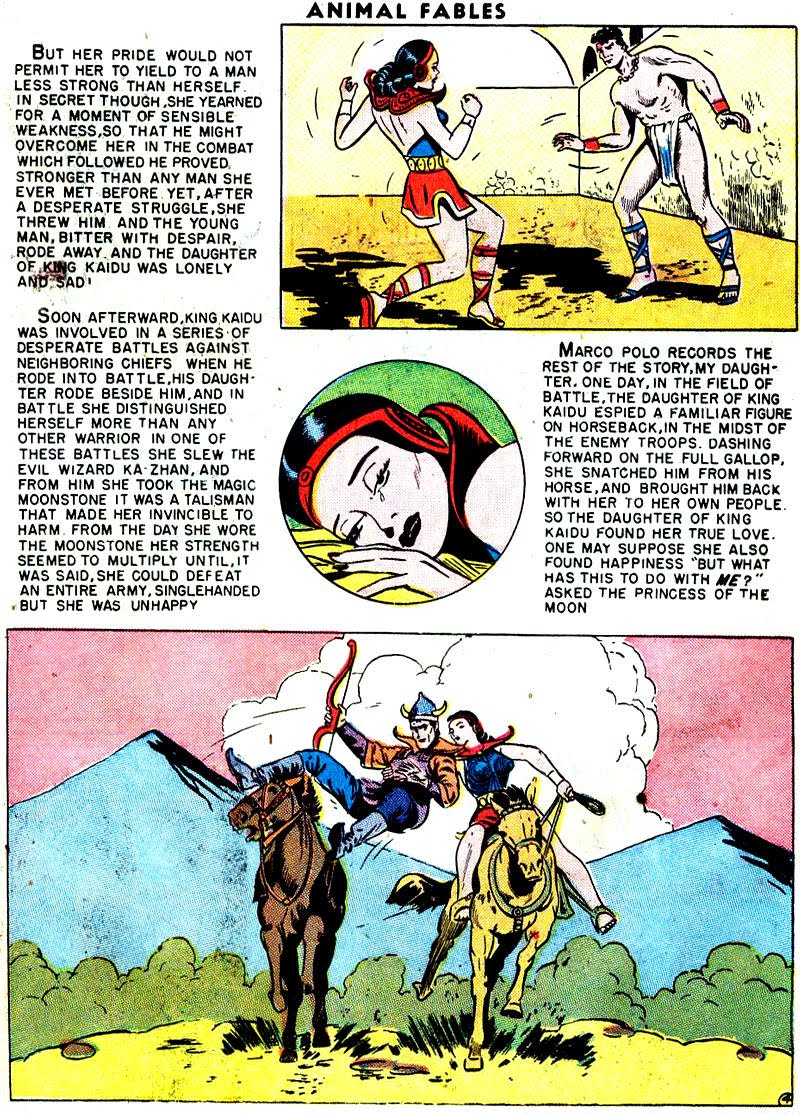
Maxwell C. "Charlie" Gaines started EC Comics after selling his All American Comics line to DC in 1945. They'd had a co-publishing arrangement for years, anyway, and Charlie Gaines' heroes, Flash, Green Lantern, Wonder Woman, et al., were assimilated by DC. We go forward to 1947, the last issue of Animal Fables, #7, and the story of the "new" Wonder Woman, Moon Girl.

There were a lot of similarities between the characters, but Moon Girl was missing a couple of key elements that made Wonder Woman so memorable: Harry Peter's outrageous artwork, and Wonder Woman creator William Moulton Marston's bondage themes. Moon Girl was drawn by Sheldon Moldoff, who had worked for Gaines at All American. Moldoff later went on to do a variety of genres, including horror comics for Fawcett, but settled in for a steady gig as Bob Kane's ghost artist on Batman in 1953.

Moon Girl was short-lived. Her comic book morphed from #1, Moon Girl and the Prince, to #2-6, Moon Girl, to #7 and 8, Moon Girl Fights Crime, and finally A Moon...a Girl...Romance. She was the only super-powered character to appear in EC Comics (unless you count Freddy Firefly or "Comics" McCormick).From the looks of the history of EC after its founder died, it's clear that his son, Bill, who inherited EC, had other ideas about what would sell, and superheroes weren't in the mix.


Thứ Năm, 6 tháng 1, 2011

Brave & Bold #57: DC's First Ambivalent Superhero


Up till this point, DC's superheroes had all pretty much relished their superpowers. And why not? Who wouldn't want to be able to zoom at super speed, or have a ring that obeys your every command, or shrink down to the size of an atom... provided, of course, that you could also be normal whenever desired.

Ben Grimm, aka the Thing from the Fantastic Four, changed all that. While he had extraordinary strength, his powers came with a curse: he looked like a pile of orange rocks 24-7. Granted, it's been done to death since, but in the early 1960s this was pretty revolutionary stuff. When the Thing was followed up by characters like the Hulk, Spiderman and the X-Men, it was clear that Marvel was onto something. Comics fans liked heroes with permanent problems, not just the temporary annoyance of a Mr Mxyzptlk or a brush with Red Kryptonite.

DC obviously took note and responded with Metamorpho. Rex Mason was a world-famous adventurer who traveled the globe. His employer was Simon Stagg, a wealthy, but unscrupulous tyrant, who also had a gorgeous daughter named Sapphire. Rex and Sapphire were engaged, much to the dismay of Stagg's brutish assistant, Java, an unfrozen caveman who was smitten with the young woman himself.

As the story begins, Rex is returning from a visit to the jungles of South America, where he was in search of the formula used by witch doctors to create their shrunken heads. He makes quite an entrance:

That turns out to be a gag he's pulled on Stagg and the mayor, who had planned a ceremony and speech to greet the famed traveler. Actually Mason had parachuted from the plane earlier and landed in Sapphire's convertible. When Stagg's goons order the pair back to the millionaire's mansion, they make the most of their time:

Cute bit, probably inspired by the James Bond flicks of the time. Stagg has a new assignment for Mason, one that will pay him enough for him to marry Sapphire:
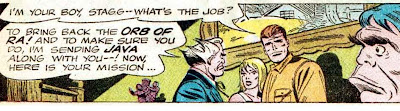
However, when they locate the hidden pyramid, problems arise. At first, the pyramid glows red hot. Then later, after finding the Orb of Ra, Java turns on Rex:

When he recovers, Rex finds himself trapped:

After passing out from the heat, Rex is surprised to discover he's still alive, but dramatically changed:

He's still sealed inside the pyramid, but "a strange thought occurs to his confused brain" and he turns gaseous, seeping through the cracks to the outside.

Java has escaped in a backup plane. Rex quickly realizes that with his new powers he can fix his damaged machine:

In the next chapter, Mason appears to have been boning up on those chemical lessons, as he seeks his revenge on Java and Stagg:

When Stagg tries to shoot him, Rex learns he's invulnerable to bullets in his new form. But not invulnerable to something else:

He and Stagg reach an uneasy truce. Stagg will try to help him get back to his normal state, and Rex will not destroy his castle. There follows a couple pages where Stagg experiments on Metamorpho, which functions mostly to define his powers. He's virtually invulnerable (except for that Orb of Ra) and he can change into almost any element found in the human body.

But Stagg is unable to reverse the incredible change. Java goes nuts and tries to burn down the castle, but Rex saves Sapphire, whose feelings have not changed:

She suggests that he use his powers for good until he can be changed back. Meanwhile, Daddy has hidden the orb in a shark tank he conveniently keeps in another part of the castle.

Comments: Entertaining origin issue, enlivened quite a bit by Ramona Fradon's artwork (embellished by longtime Batman inker Charles Paris). The story was written by Bob Haney. Oddly enough, when DC came up with their next conflicted superhero, he had a very similar quadrifurcated appearance:

There was at least one significant difference between Metamorpho and the Thing. While both were appalled at their freaky-freak McAlien freak appearance, Ben was capable of being irascible even about other things, while Rex remained pretty much happy-go-lucky except about his appearance.